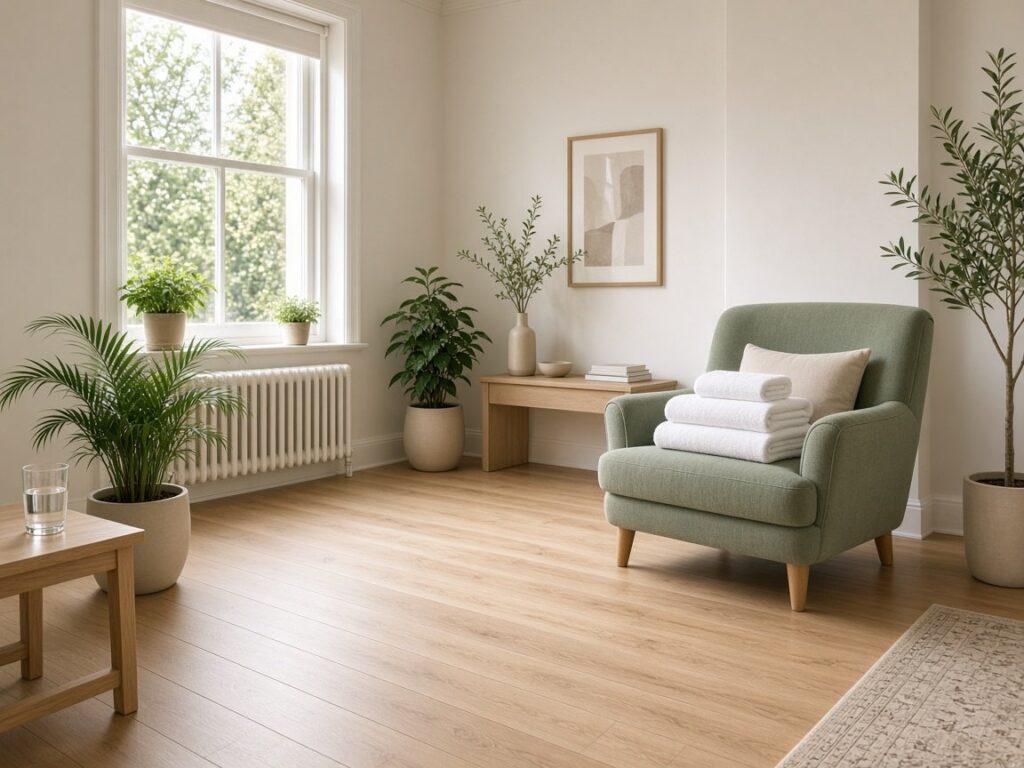
Preparing Your Home for a Professional Wellness Visit in London
You have arranged time away from emails, deliveries and the demands of everyday life. The appointment is on your calendar, but the room is still doing its usual job: a laptop on the dining table, shoes by the door and a narrow passage between the sofa and the window. How much needs to change before a visiting massage practitioner arrives?
Less than you might think. Preparing your home for a professional wellness visit means making one room clean, private, accessible and safe for the agreed treatment. You do not need to recreate a luxury spa or buy decorative equipment. You do need to confirm what the practitioner will bring, where they will work, and whether the available space actually suits the service.
Begin with the confirmed appointment, not the room decoration
Before shifting furniture, check what you have booked. A mobile massage may use a portable table, a specialist mat or another professionally approved setup. Different formats need different floor space, positioning and equipment. A general description of a home visit cannot tell you which arrangements your practitioner uses.
Ask for written confirmation of the treatment, duration, agreed address, arrival window, equipment, total price and any preparation instructions. Confirm whether setup and packing time are separate from the hands-on session. Tell the provider about concierge or visitor rules.
This article is a planning guide, not a claim that every treatment at Velvete Tantric London is offered as a home visit. Availability and the conditions of a particular booking need direct confirmation.
Choose a room where the practitioner can move safely
A room can fit a massage table but still be unusable if there is nowhere to stand alongside it. Imagine a compact London flat where a folded table fits between a bed and wardrobe. If opening the wardrobe blocks the door and one side of the table touches a wall, the practitioner may have insufficient working room.
Choose the room with the clearest circulation space, even if it is less photogenic than the bedroom. A living room, study or spare room may work. Move coffee tables, bags, loose rugs and trailing cables away from the proposed treatment area. Leave the exit and the route to the bathroom unobstructed.
Do not rely on a universal minimum room measurement. Portable tables and treatments differ. Tell the practitioner the usable floor dimensions, not the size of the entire room, and ask how much clearance they need on each side. A photograph, if you wish to share one, may help.
Think about the route from the front door
Home preparation starts in the hallway. A practitioner carrying a table or other supplies may need to navigate external steps, a coded entrance, a lift, a shared stairwell and a second locked door. London conversions can have tight corners that are not obvious from the postcode.
Check whether the lift is working, and mention any steps or unusual access arrangements. If parking or unloading is difficult, ask what information is useful, but do not assume that parking is included or that the practitioner can carry equipment indefinitely. Give accurate directions, including the entrance visitors should actually use.
Keep any route through your home clear. Move fragile objects from the route beforehand.
Confirm what will arrive with the therapist
Some mobile providers bring a massage table, fresh linen, oils and positioning cushions. Others may require agreed client supplies. The equipment list depends on the specific business and treatment, so ask instead of laying out everything you own.
A sofa or ordinary bed is not necessarily an acceptable substitute for a professional table. Its height and softness may make safe working difficult. If you have accessibility requirements or cannot comfortably use a standard table, raise that during the enquiry so the provider can assess possible alternatives.
Provide only agreed supplies, clean and dry. Avoid heating oils or preparing equipment yourself unless the practitioner has explicitly instructed you to do so. Proper product handling and treatment setup remain professional responsibilities.
Keep hygiene straightforward and visible
The treatment area should be reasonably clean and uncluttered. Clean a surface for supplies and provide a bin if requested. Keep food preparation, dirty laundry and pet bedding away from the setup.
A visiting practitioner should follow appropriate hand hygiene and equipment-cleaning procedures. The UK National Occupational Standards for body massage address clean materials, prevention of cross-infection, environmental suitability and informed consultation. The NHS handwashing guidance explains good hand hygiene for everyday settings.
Provide access to a functioning sink with soap and a clean way to dry hands, or ask what hygiene arrangements the practitioner requires. Do not assume that a bottle of hand sanitiser replaces every aspect of handwashing or equipment cleaning. If anyone in the household has an infectious illness, discuss postponement rather than concealing the situation.
Plan privacy around the people who actually live there
Privacy is easier to arrange before the doorbell rings. If you share a flat, tell household members which room will be in use and roughly when. Arrange childcare where needed rather than expecting a therapist to supervise children or work around repeated interruptions. If a family member must be present for a support reason, discuss their role and where they will be during the appointment.
Close curtains or blinds if neighbouring windows overlook the room. Check that the door can be closed without creating an unsafe or obstructed exit. Put away private paperwork, valuables and items you would rather not leave on display.
For hands-on treatment, agree clothing, draping, positioning and boundaries directly with the practitioner. A home appointment should meet the same professional standards of informed consent and respect as a studio visit. You can ask for changes or end a session if you become uncomfortable. Velvete also discusses individual preferences in its guide to customised massage experiences.
Decide what to do with pets before arrival
A friendly dog may still jump at a portable table. A cat may become curious about bags, oils or folded towels. Even a quiet animal can interrupt setup or create a trip hazard.
Arrange for pets to remain safely in another room for arrival, treatment and packing, unless the provider has agreed to a different arrangement. Tell the practitioner about any animal they may encounter on entry. Avoid leaving pet food or toys in the treatment space, and clean your hands after handling animals before setting out any shared supplies.
The aim is a safe working area, not keeping pets away all day.
Adjust warmth, light and sound for two people
A treatment room should feel comfortable to the client and practical for the practitioner. Warm the room if it is cold, but avoid overheating it. Keep a little ventilation where possible, and make sure the practitioner can see clearly enough to set up and move around safely.
Soft lighting is a preference, not a requirement. Candles introduce open flames near textiles, oils and equipment, so electric lighting is usually the simpler option. Silence is fine; incense and diffusers are unnecessary. If fragrance is uncomfortable for you, mention that in advance rather than adding a scented product to make the home smell like a spa.
Place your phone on a suitable quiet setting, while keeping a way to communicate in an emergency. The point is fewer avoidable interruptions, not isolation from necessary contact.
Confirm professional identification and arrival arrangements
Inviting a service provider into your home requires sensible checks on both sides. Book through a recognised channel, verify the business and agree how you will identify the practitioner when they arrive. Do not share a door code or sensitive access information more widely than necessary. Ask what happens if the assigned practitioner changes.
The UK’s Health and Safety Executive guidance on lone working highlights employers’ responsibilities to assess risks and maintain contact with people working alone. That is employer guidance, not a checklist you must administer yourself, but it helps explain why a practitioner may follow check-in procedures or decline an unsafe setting.
Respect the agreed appointment and professional boundaries. If the property, other occupants or access arrangements differ substantially from what was disclosed, the practitioner may need to reassess whether the visit can proceed.
A realistic preparation timeline
A short preparation timeline can prevent last-minute rearranging.
| When | What to do |
|---|---|
| Before confirming | Check service coverage, room requirements, supplies, access, price and policy |
| The day before | Clear the working space, tell household members and confirm the entrance |
| About an hour before | Check warmth, lighting, sink access and the route through the home |
| Shortly before arrival | Settle pets, reduce interruptions, have agreed supplies ready and keep your phone reachable |
| At arrival | Confirm identification, discuss the setup and revisit comfort preferences |
Leave time for arrival and packing up rather than scheduling back-to-back commitments.
What if the room turns out to be unsuitable?
Sometimes a planned setup does not work. A table may not fit through a narrow doorway. A lift may fail. A room may be too crowded to provide safe working clearance. The right response is not to force the equipment into place or ask the practitioner to work in an unsuitable position.
Discuss alternatives before treatment begins. Depending on the provider, these might include another room, a different professional setup, rescheduling or switching to a studio appointment. Check booking terms for potential fees. A clear policy is particularly important when space and access are uncertain.
The same applies if you become unwell or a new household issue makes the visit impractical. A professional appointment should not depend on ignoring a safety concern to avoid inconvenience.
Frequently asked questions about preparing for a home massage
These are general preparation answers for professional mobile wellness services. Specific instructions always come from the provider you have booked.
Do I need a separate massage room?
Not necessarily. A living room, bedroom or study may work if it offers enough safe working space and privacy. Ask the practitioner to confirm the required clearance for their equipment and treatment. A small but open room may be more suitable than a larger room packed with furniture.
Should I provide my own massage table or oils?
Only if this has been agreed in advance. Many mobile practitioners provide their own equipment and products, but not all services operate the same way. Do not assume a household bed is suitable or use an unfamiliar oil without discussing ingredients and professional requirements.
How clean does my home need to be?
Focus on the treatment area and access route. They should be reasonably clean, free from obstacles and suitable for hygienic setup. The practitioner remains responsible for professional equipment, linen and hand hygiene. You do not need to deep-clean every room in your home.
Can a therapist visit if I have children or pets at home?
That depends on whether a safe, private, uninterrupted appointment can be arranged and on the provider’s policy. Organise appropriate childcare and keep pets away from equipment and treatment areas. Mention any unusual circumstances before booking rather than expecting immediate improvisation.
What if I live in an upstairs London flat?
An upstairs flat is not automatically unsuitable. Tell the provider about stairs, lift access and equipment-carrying requirements. A practitioner may have practical limits on what can be transported safely, so confirm suitability before finalising the appointment.
Is preparing my home the same as agreeing to treatment?
No. Making space available does not replace a professional consultation or informed consent. The practitioner should explain the agreed service and respect boundaries. You may raise concerns, request adaptations or decline treatment even after the equipment has been set up.
Make the room workable, then let the appointment be simple
A successful home wellness visit is not measured by candles, matching towels or a room that looks ready for a photograph. It begins with an honest description of the space, clear access instructions, sensible hygiene, privacy and an agreed plan for the practitioner to work safely.
Keep the preparation proportional to what you have booked. A clear floor, a comfortable room and a few thoughtful conversations are often more useful than turning the house upside down. If you are considering a mobile appointment, contact Velvete Tantric London to confirm whether home visits are currently available and what arrangements would be required at your address.