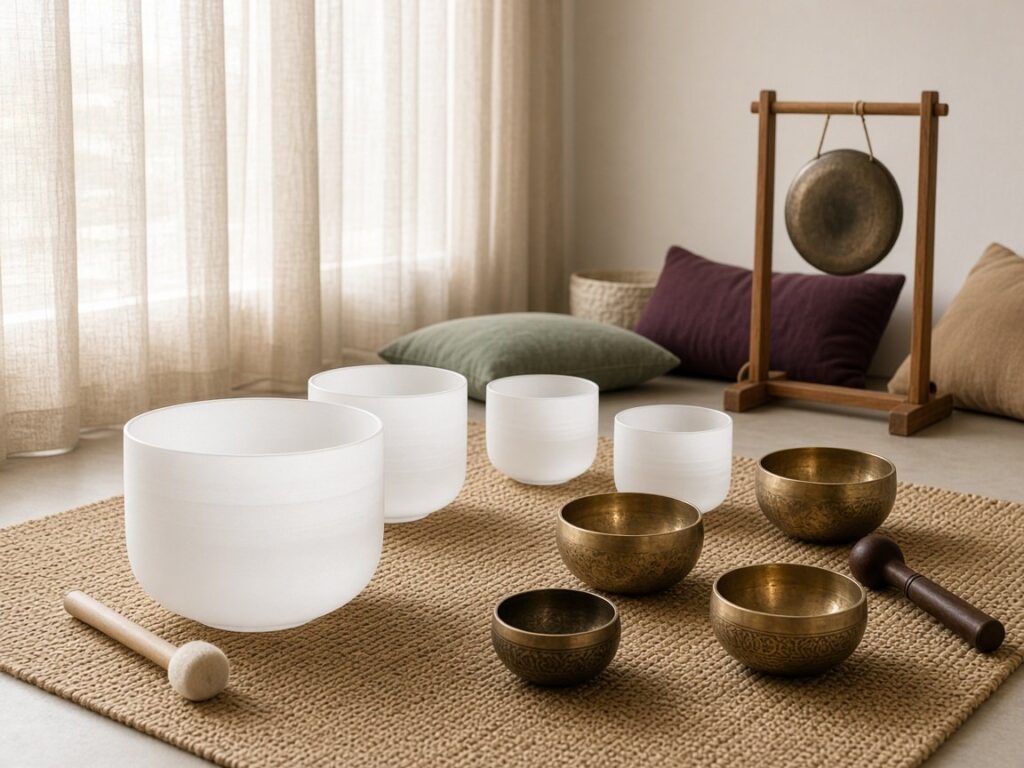
Tantric Sound Healing vs a Sound Bath: What Is Different?
London has no shortage of places promising a pause from constant noise. A studio might advertise a gong bath, another might offer singing bowls, while a private practitioner describes a session involving sound, breathing and mindful attention. The names can make these experiences seem interchangeable. They are not necessarily the same.
The most useful distinction is not whether a gong or a bowl appears in the room. It is how the session is organised, how much individual guidance you receive and how comfortable you feel with the sounds.
What is the difference between tantric sound healing and a sound bath?
A sound bath is generally a listening-focused experience in which a facilitator plays instruments such as singing bowls, gongs or chimes while participants rest and listen. It often takes place in a group, although private sound baths also exist.
Tantric sound healing is not a standardised clinical treatment or a single agreed method. In contemporary wellness settings, the term may describe a private session that brings together sound, conscious breathing, meditation, intention-setting or ideas drawn from modern tantric practice. What is actually included varies between practitioners. Neither label, on its own, tells you the session’s length, volume, degree of interaction or likely suitability.
What usually happens during a sound bath?
Imagine arriving at a small London yoga studio after work. Shoes are left by the door, people settle onto mats, and the facilitator briefly explains the session. Once everyone is comfortable, conversation stops. The room fills with an unfolding sequence of tones: perhaps a clear bowl note, a gentle chime, then the deeper wash of a gong.
Participants usually listen rather than perform. Some close their eyes; others prefer to keep them open.
A sound bath might use crystal or metal singing bowls, gongs, bells, drums or recorded sound. Facilitators have different approaches to timing, volume and silence. Some begin with guided breathing; others allow the sounds to carry the whole experience.
What might a private tantric sound session involve?
A private sound-based wellness session offers a different possibility: the practitioner has more room to adapt the experience to one person’s preferences. That could mean discussing what kind of sounds feel pleasant, whether verbal guidance is welcome and how much silence the person would like between instruments.
Where a practitioner uses the term tantric, they may introduce an element of body awareness or reflective attention. Others may include chanting or simple vocal exercises, but these should never be assumed or required.
This is a description of possible approaches across the wellness sector, not a fixed protocol. Sound work, tantra-informed meditation and professional music therapy are different things. Before booking, ask the provider to explain exactly which activities are part of the appointment.
Sound bath or private session: a practical comparison
A side-by-side view helps clarify the usual differences, although every provider sets their own format.
| Question | Typical group sound bath | Private sound-based session |
|---|---|---|
| Who takes part? | Several participants, often in a studio | Usually one client and a facilitator |
| Main activity | Listening to a planned sound sequence | Listening, potentially with personalised guidance |
| Opportunity to talk | Usually before or after, not throughout | Often more scope for questions and adjustments |
| Sound level | Shared with everyone in the room | May be easier to tailor, depending on the provider |
| Atmosphere | Collective, quiet and structured | Individual, conversational or contemplative |
| Best reason to choose it | You enjoy shared stillness and simple participation | You value privacy or want to discuss preferences |
These are common patterns, not universal rules. A small group class may be exceptionally attentive, while a private appointment may follow a predetermined routine. The practitioner matters more than the category.
Why the word ‘tantric’ needs a closer look
Tantra has a long and varied history within South Asian religious and philosophical traditions. Some modern wellness programmes borrow breath awareness, mantra or meditation from those traditions. These adaptations are not equivalent to traditional tantric study.
In a sound-focused session, the practical question is straightforward: what does the tantric element change for the participant? Perhaps the facilitator adds a short settling exercise. Perhaps there is a guided moment of reflection.
An informed practitioner should be able to describe the activity without promises about invisible energy being medically corrected. You do not need to adopt any spiritual belief to enjoy mindful listening, and you should be free to decline exercises that do not suit you.
For a broader look at how contemporary London studios discuss these practices, our article on energy healing in London’s tantric studios explores the language and traditions used in the sector.
Do the instruments make one experience better?
A crystal bowl can sound bright and sustained. A metal bowl might produce a more layered, resonant tone. Chimes bring short, delicate notes; a gong can build into a much fuller sound. None of those instruments automatically makes a session more effective, more spiritual or more suitable for every listener.
Ask about instruments before booking, especially if there will be powerful percussion. A provider who can explain how the sound develops through the session offers more useful information than one who promises that a particular frequency will solve a problem.
The role of breath, attention and silence
Breath awareness does not have to be complicated. A facilitator may invite you to notice an ordinary inhalation and exhalation, without forcing a particular rhythm.
A few quiet moments between tones allow participants to notice the difference between sound and stillness. In private sessions, there may be more room to request these pauses. Group experiences often rely on the facilitator’s planned sequence, so individual requests can be harder to accommodate during the event.
If breath exercises make you uncomfortable, you can simply listen. A worthwhile wellness experience should not depend on everyone following the same instructions in exactly the same way.
Choosing a session when you are sensitive to noise
The word relaxing does not mean quiet. Gongs in particular can become surprisingly loud, and tones that one participant enjoys may feel sharp or overwhelming to another. This matters if you experience tinnitus, migraines triggered by sound, hearing sensitivity or discomfort around sudden noises.
The NHS guidance on noise sensitivity explains that ordinary sounds can sometimes feel unusually loud or painful. If sound is painful, speak to a healthcare professional rather than relying on a wellness provider to assess the problem. The World Health Organization’s safe-listening guidance also makes clear that loudness and duration both matter for hearing health.
Before attending, ask whether the session includes sudden gong strikes, how close participants sit to instruments, whether the volume can be reduced and if leaving the room is straightforward. No one should be pressured to endure uncomfortable sound to achieve a promised result.
Privacy, consent and personal comfort
For some Londoners, the biggest difference is the social setting. A busy professional may enjoy being anonymous in a group, where nobody expects a personal conversation. Another person might value the discretion of a one-to-one appointment, particularly if they prefer to explain their needs before the experience begins.
Privacy is not guaranteed by the word private. Check where the appointment takes place, who will be present, whether other clients can hear discussions and how booking details are handled. If a session involves physical contact, positioning an instrument near the body or any other hands-on element, the practitioner should explain that beforehand and seek clear permission.
You can change your mind during a session. You can ask for less sound, decline guidance, request a pause or leave.
What does research actually say about sound and wellbeing?
Listening to music can influence mood and attention, and researchers have investigated music-based approaches in a range of settings. However, research on music-based interventions is not proof that a specific sound bath or tantric sound session treats a medical condition.
The US National Center for Complementary and Integrative Health describes promising findings in parts of music research while emphasising that evidence quality varies and more rigorous studies are needed. It also distinguishes professional music therapy, delivered by appropriately trained therapists, from other activities that involve music or sound.
Keep that distinction in mind when reading advertisements. A singing-bowl session might be enjoyable and offer a welcome opportunity to slow down. It should not be sold as a replacement for assessment or treatment of anxiety disorders, hearing conditions or other health problems.
How to choose between the two in London
Start with the experience you actually want rather than the label on a booking page. If you hope to sit quietly among other people with little conversation, a group sound bath may be the natural fit. If you want to ask questions, adjust the pace or discuss sensory preferences, explore a private session.
Check the venue’s precise address, accessibility, arrival instructions and what to bring. Mats, blankets and cushions may be supplied, but policies differ. Comfortable layers can make it easier to settle after work.
For a first visit, clarity matters more than elaborate descriptions. A helpful listing explains the session’s format, approximate length, group size, instruments, level of participation and practical arrangements.
Questions worth asking before you book
You do not need a long consultation to establish whether a session sounds right. These questions usually reveal the essentials:
- Is this a group sound bath or a one-to-one appointment?
- Which instruments or recordings will be used, and can I hear an example?
- Will there be guided breathing, chanting, movement or physical contact?
- Can sound volume or the pace of the session be adjusted?
- What should I do if I need a break or feel uncomfortable?
- What training does the facilitator have in this particular method?
- What is included in the price, and what are the cancellation terms?
You are choosing a setting for personal relaxation, so your preferences should be taken seriously.
Frequently asked questions
Is tantric sound healing the same as a sound bath?
Not necessarily. A sound bath is usually centred on listening to instruments, often alongside a group. A modern tantra-informed sound session may include private guidance, breath awareness or reflective practices. Neither term has one universal format, so ask what the provider actually offers.
Do I have to chant or practise meditation?
No. Some sessions include a guided exercise, but others are entirely listening-based. You should know about any participation requirements before booking and be able to decline an activity that does not feel right for you.
Is a private sound session always quieter?
No. Private appointments may allow more control over volume, but the instruments can still be powerful. Ask about the sound level and what adjustments the facilitator can make rather than assuming privacy means low volume.
Can sound healing replace medical care?
No. A wellness sound session is not a substitute for medical advice, diagnosis or treatment. Anyone with ongoing physical or mental health concerns should seek appropriate healthcare guidance. The benefits of a pleasant listening experience should not be confused with a medical promise.
How long does a sound bath take?
There is no universal duration. Some events are short introductions; others include a longer listening period and time to settle before leaving. Check the actual session length and whether arriving early is expected.
What should I wear to a sound session?
Comfortable clothing that lets you sit or lie down without distraction is usually sensible. Consider bringing an extra layer if you tend to feel cool while resting. Ask the organiser whether mats, blankets and cushions are provided.
A quieter choice starts with clearer information
A sound bath offers one way to step out of London’s constant stream of messages, traffic and appointments. A private, tantra-informed sound experience may offer more opportunity to shape that pause around your preferences. Neither is inherently superior. The better option is the one whose format, sound levels and boundaries feel right to you.
If you are exploring mindful wellness in London, contact Velvete Tantric London to ask which sound-based or other relaxation experiences are currently offered and what each appointment includes.