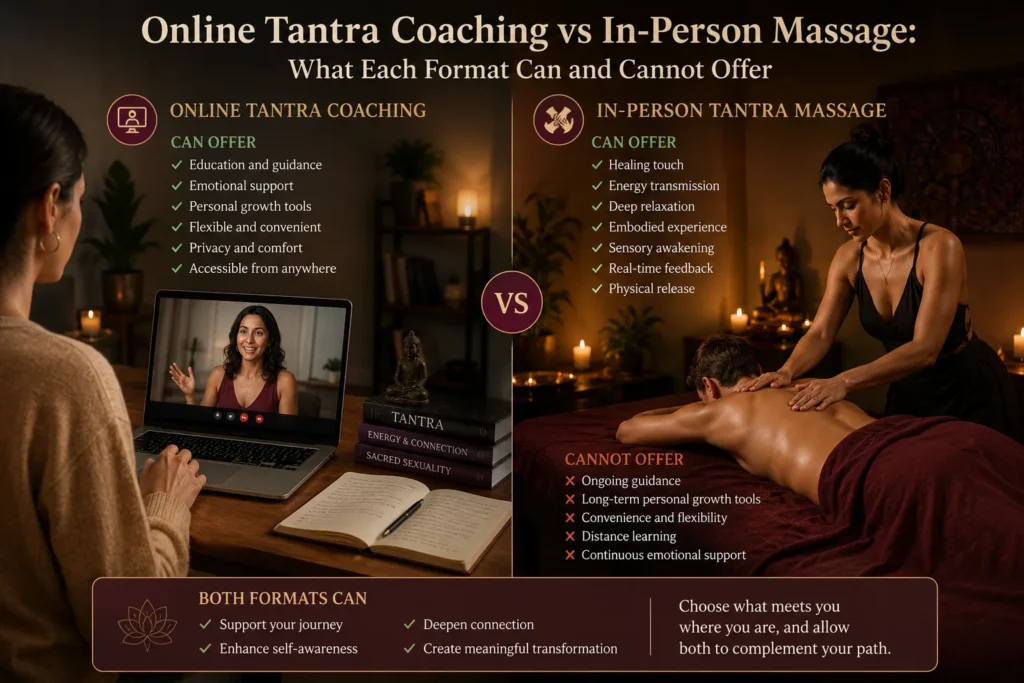
Online Tantra Coaching vs In-Person Massage: What Each Format Can and Cannot Offer.
Online tantra coaching and physical massage sessions deliver distinct physiological results for paying clients. They serve completely different physical needs in the human body. Coaching via a video call focuses strictly on vocal communication. This remote method requires intense mental focus from the student. A trained practitioner instructs the client to control specific pelvic floor muscles. The coach delivers these instructions through clear verbal commands. But the physical in-person format involves direct tissue manipulation by a trained worker.
This direct physical contact provides immediate nervous system regulation. Interested people must understand the precise technical limits of each distinct option. Then they can book the correct therapeutic service for their bodies. Both formats aim to reduce nervous system arousal. But they use opposite mechanical methods. The digital format relies on conscious mental effort. The physical format relies on passive bodily reception.
The Structural Mechanics of Remote Video Instruction
Remote online sessions deliver concrete anatomical information directly to the paying client. A remote coach explains the exact physiological responses of the nervous system. The practitioner demonstrates specific breathing patterns on a live computer camera. And the clients learn precise timing for specific muscle contractions. They practice these physical techniques through live video instruction at home.
The remote coach watches the client on a computer monitor. Then the coach provides immediate corrective verbal feedback to the student. This digital method builds cognitive awareness of internal bodily processes. The client must learn to isolate specific muscle groups without physical guidance. And this process takes several weeks of continuous daily practice. The coach cannot physically adjust the posture of the remote student. So the client must rely entirely on verbal descriptions to find the correct physical alignment.
The Rigid Physical Barrier of Digital Screens
This digital method cannot replicate the complex biochemical reactions triggered by direct physical touch. The digital screen forms a rigid physical barrier between the coach and the individual. Remote clients do not receive the deep muscular tension relief of a physical session. The human brain reacts differently to a flat digital image.
The body does not release oxytocin during a remote video call. So the client remains in a highly alert cognitive state during the entire session. The remote format works well for transmitting raw data and specific mechanical sequences. But it fails to address deep physical tissue blockages. A video call cannot manipulate stiff human fascia. And a digital connection cannot warm cold muscle fibers.
The Tangible Impact of Direct Physical Contact
Physical in-person sessions deliver tangible physical results through applied mechanical pressure. The physical format treats the human body like a connected biological machine. Direct tactile touch creates immediate measurable changes in the human nervous system.
Applying Mechanical Pressure to Human Tissue
- A professional massage involves a trained practitioner working directly on targeted muscle groups.
- The physical practitioner applies warm massage oil to the skin to prepare the muscles.
- These deliberate hand movements release deep fascia blockages in the human body.
- Many interested individuals seek out a tantric massage in London to experience this direct physical release.
- The physical pressure forces stagnant blood out of tight muscle tissue.
- Fresh oxygenated blood flows into the treated areas of the physical body.
- The practitioner reads subtle micro-expressions on the face of the client.
- The practitioner adjusts their physical hand pressure immediately based on these facial expressions.
- This immediate physical feedback loop prevents unnecessary pain for the receiving client.
Creating a Controlled Clinical Environment
A proper studio setting provides a controlled room temperature for the client. The room includes ambient lighting to aid physical relaxation. A reputable clinic offering a massage in London maintains strict environmental standards. The practitioner controls the audio volume of background sound to prevent sudden startling noises.
The client lies on a padded table for sixty or ninety minutes. The ambient temperature remains fixed at twenty-two degrees Celsius. This warmth prevents the muscles from contracting defensively. The physical environment forces the parasympathetic nervous system to activate. And the resting heart rate of the client drops within the first ten minutes.
Preparing for the Chosen Physical Service
Clients must prepare differently for a remote video call and a physical appointment. The physical session requires specific hygienic and logistical preparations. The online session requires only a stable internet connection and a private room.
Reviewing Standard Clinic Protocols
Clients often prepare for physical sessions by reviewing a tantric massage guide prior to the appointment. This written material helps them understand the basic mechanical steps of the physical process. And new clients frequently bring first-time massage questions regarding standard clinic draping protocols. They ask about specific clinical hygiene requirements for the scheduled session.
The clinic staff answers these specific queries clearly prior to the starting time. The practitioner explains exactly which body parts remain covered by towels. And the practitioner details the exact physical boundaries of the session. Clear verbal boundaries reduce the baseline anxiety of the new client. The client undresses in complete privacy. Then the client lies under a clean cotton sheet.
The Daily Commitment of the Remote Client
Online video coaching relies entirely on the daily dedication of the client at home. The remote coach assigns specific physical exercises to the student. Then the student must practice these exercises for twenty minutes every single day. The online format serves the client with a structured educational curriculum.
The physical in-person format provides a passive therapeutic treatment. So each distinct service format requires a very different level of personal responsibility. The physical massage delivers immediate results with zero effort from the client. But the online coaching requires intense mental labor to produce any physical changes.
Measuring the Tangible Results of Each Format
Clients want to know the exact physical outcomes of their purchased services. Both formats produce measurable changes in the human body. But these changes occur on entirely different timelines.
Tracking Immediate Physical Changes
The physical in-person format treats acute physical stress in the body. The massage relieves deep muscular tension within a single sixty-minute session. A blood pressure cuff will show a marked decrease in physical arousal immediately afterward. The client experiences increased joint mobility for roughly forty-eight hours.
Then the body slowly returns to its baseline state of tension. A regular weekly appointment maintains these loose muscle fibers. But a single session does not teach the client to regulate their own nervous system. The client depends entirely on the physical labor of the practitioner to achieve relaxation.
Building Long-Term Neurological Pathways
The online coaching format builds permanent neurological pathways in the human brain. The client learns to drop their own heart rate using specific breathing mechanics. This learned skill remains available to the client at all times. A remote session does not loosen tight shoulder muscles directly. But it teaches the client to stop clenching those muscles during stressful events. The results of remote coaching take three to four weeks to manifest. The client must repeat the exercises multiple times. Then the physical movements become automatic. And the nervous system begins to self-regulate without the presence of the coach.
Comparing the Specific Technical Interventions
The specific physical techniques differ drastically between the two distinct formats. The online coach relies on breath manipulation and pelvic floor isolation. The massage practitioner relies on friction, compression, and skin traction.
Breathing Mechanics in Digital Coaching
The remote coach instructs the client to inhale for four distinct seconds. Then the client must hold the breath for two seconds. And the client exhales slowly for six seconds. This specific mathematical ratio forces the vagus nerve to send calming signals. The coach watches the rib cage of the client on the video screen.
The coach corrects the client by pointing out shallow chest breathing. The client must learn to expand the lower diaphragm instead of the upper chest. This mechanical correction requires extreme patience from both parties. The digital screen limits the visual field of the coaching professional. The coach cannot see the lower body of the client clearly. So the verbal descriptions must carry total mechanical precision.
Friction and Compression in Physical Therapy
The massage practitioner uses the palms of their hands to apply broad physical compression. This compression targets the large muscle groups of the human back and legs. Then the practitioner uses their thumbs to apply targeted friction to specific muscle knots. This friction creates localized heat in the muscle tissue.
The heat melts the stiff collagen fibers holding the knot together. The physical practitioner uses their own body weight to deliver deep pressure. The client breathes deeply to assist the physical release of the tight tissue. This collaborative physical process requires absolute trust between the two individuals in the room. The physical touch provides a constant stream of sensory data to the brain of the client. This massive sensory input overrides the internal anxiety loop in the mind.
Selecting the Correct Format for Physical Mobility
Prospective clients must evaluate their own physical mobility limits. The choice between digital coaching and a physical appointment often depends on physical logistics.
Navigating Geographic Limitations
Many clients live in remote rural areas without local access to physical clinics. These individuals rely exclusively on digital video coaching for nervous system education. A computer and an internet connection provide immediate access to a trained professional. The digital format eliminates travel time and physical transportation costs.
The client completes the session in their own private bedroom. Then they can sleep immediately after the session concludes. This convenience appeals to individuals with demanding daily schedules. A one-hour digital session fits easily into a standard lunch break.
Addressing Acute Physical Pain
But clients with severe muscular pain require immediate physical intervention. A tight sciatic nerve will not respond quickly to remote breathing exercises. The client needs a professional practitioner to physically manipulate the stuck tissue. A direct physical session targets the exact anatomical source of the pain.
The hands of the professional locate the exact center of the muscle spasm. Then the applied pressure forces the spasm to release its grip on the nerve. The digital format simply cannot address acute mechanical injuries in the human body. So the client must travel to a physical clinic to receive proper manual therapy. Each unique service format treats a very specific set of physiological problems.
Where to find us?
Collingham place,
SW5 0PZ, London
Tel: +442045771071
Email: velvetelondon@gmail.com
We are available (GMT)
| Monday | : | 09:00 – 23:00 |
| Tuesday | : | 09:00 – 23:00 |
| Wednesday | : | 09:00 – 23:00 |
| Thursday | : | 09:00 – 23:00 |
| Friday | : | 09:00 – 23:00 |
| Saturday | : | 09:00 – 23:00 |
| Sunday | : | 09:00 – 23:00 |